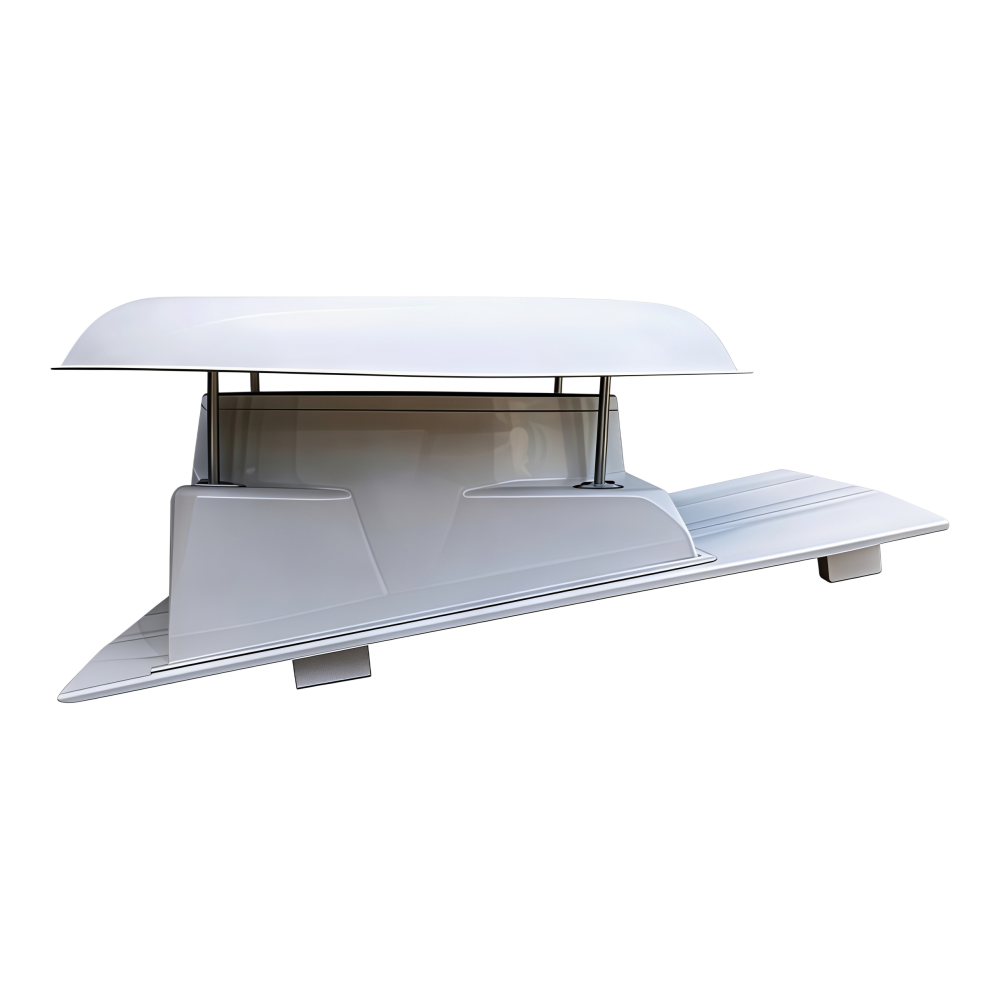
Slope-type FRP rooftop exhaust fan
DH-WD1460 and DH-WD1060. Waterproof dome cap, six axial blades, 28,000 to 45,000 m³/h.
Rooftop exhaust fans from Foshan, China — FRP slope and elbow fans, carbon-steel and FRP axial DWT-I roof fans, for factories, warehouses, farms and commercial buildings.
A rooftop exhaust fan has one job: move hot, stale air out of a building through the roof, and let fresh air in to replace it. This site lists the four rooftop fan families the manufacturer publishes, with the specification tables from its own product pages, so buyers can compare models on verified figures instead of catalogue claims.
DH-WD1460 and DH-WD1060. Waterproof dome cap, six axial blades, 28,000 to 45,000 m³/h.
DH-1460EL, DH-1260EL, DH-1060EL and DH-850EL. Fibreglass housing, PVC shutters, 28,000 to 45,000 m³/h, 55 to 65 dB.
Eleven tabled models, DWT-I-3A to DWT-I-11.2A, with the carbon-steel dimension table.
The same eleven DWT-I rows with the FRP dimension table and FRP-only gas limits.
Every fan family on this site serves the same basic need — exhaust air through the roof — but the families differ in housing material, shape, size range, and the tables that describe them. A factory with a large roof opening and a need for high airflow looks first at the DWT-I axial range, whose tabled models run from 1,900 m³/h on the smallest operating point to 53,855 m³/h on the largest carbon-steel row. A poultry house or greenhouse looks first at the FRP slope and elbow families, whose pages list agricultural buildings among their applications and whose airflows run from 28,000 to 45,000 m³/h. A commercial building looks at the same FRP families and at the elbow noise figures, which run from 55 to 65 dB depending on model. The right starting point is always the same three facts: what building the fan serves, what roof opening is available, and what voltage stands at the fan position. The guide page walks through those three facts in order.
Each family page reproduces the specification table from the manufacturer's own product page for that family, with the same models, the same figures, and the same column headings. Where a table lists two figures separated by a slash, the page lists two operating points, not a range to pick from freely: the DWT-I tables, for example, list two powers, two speeds, two airflow ranges and two pressure ranges per model, because each model is tabled at two operating points. Where two source pages disagree by a small amount — the DWT-I-11.2A top airflow is 53,855 m³/h on the carbon-steel page and 53,800 m³/h on the FRP page — each family page quotes its own page's figure, and the difference is stated rather than smoothed over. Where a source page states a series-level claim, such as the carbon-steel page's 17 machine numbers or its 15,000 to 220,000 m³/h series airflow, the claim is labelled as a page-level claim, and only the eleven tabled rows are given per-model specifications. Nothing on this site states a minimum order quantity, a lead time, a price, or a certificate number, because none of those appears on the source pages. The contact form carries the standard note: confirm those items before payment.
The slope and elbow pages list industrial workshops across textile, garment, glass, molding, rubber, coating, toy, electronics, shoe, printing, food, dyeing and laundry trades, plus large farms, greenhouses and livestock farms, plus civil and commercial spaces such as stores, supermarkets, halls, food markets, waiting rooms and recreation places. The carbon-steel DWT-I page lists warehouses, factories, power stations, bus stations and gymnasiums, and describes its range as medium-to-low-pressure, high-airflow applications. The FRP DWT-I page lists industrial facilities, warehousing and logistics, transportation hubs, commercial and public buildings, and energy and infrastructure projects. The application pages on this site — warehouse, factory, poultry and greenhouse — take their application lists from those pages only, and say so where the list ends and buyer questions begin.
Searches for rooftop air ventilator mostly return passive vents: wind-driven turbine vents, roof-vent guides, and marketplace vent listings, with no industrial powered-fan manufacturer in the top results. A passive vent has no motor and no stated airflow; a powered rooftop exhaust fan has a motor, a rated power, and a tabled airflow. Buyers who need a stated airflow need the powered families on this site. Buyers who need a passive vent need a different product class, and this site does not sell one. The ventilator guide page sets out the distinction in full, so the two are not confused at ordering time.
The table below compares the four families on the figures their own pages publish. It is a summary for orientation only: the full tables, with every row, stand on the family pages, and any figure used for ordering must be taken from the full table of the family being ordered, not from this summary.
| Family | Models tabled | Airflow (m³/h) | Power and speed | Noise | Dimensions |
|---|---|---|---|---|---|
| Slope-type FRP | DH-WD1460, DH-WD1060 | 28,000 / 45,000 | 0.75 / 1.1 kW, 560 rpm | Not published | 1060–1460 mm square, hole 1000 / 1400 mm |
| Elbow-type FRP | DH-1460EL, DH-1260EL, DH-1060EL, DH-850EL | 28,000–45,000 | 0.37–1.1 kW, 540 / 680 rpm | 55–65 dB | 850–1460 mm square |
| Carbon-steel DWT-I | 11 rows, DWT-I-3A to 11.2A | 1,900–53,855 | 0.18–7.5 kW, 710–2900 r/min | Not published | Five-column scheme, own page |
| FRP DWT-I | 11 rows, DWT-I-3A to 11.2A | 1,900–53,800 | 0.18–7.5 kW, 710–2900 r/min | Not published | Seven-column scheme, own page |
Two cautions apply to the whole table. First, the DWT-I airflow figures are the ends of the tabled ranges across all operating points, not the airflow of any single model: each DWT-I row carries two operating points, and the row must be read across, not down. Second, the noise column is honest about its gap: only the elbow family publishes noise figures, and the other three families are marked as not published rather than given an estimated figure. A summary that filled those gaps would be inventing data, and this site does not do that.
One figure is shared across the slope and elbow families and is worth stating plainly: both run on 380 or 220 volts at 50 hertz, with the slope page noting that special voltage and power parameters can be customized. That commonality simplifies spares and controls where both families serve one site, but it does not extend to the DWT-I tables, which list power and speed without a voltage column. Voltage for a DWT-I model is therefore confirmed model by model, and a buyer who assumes the slope and elbow voltages carry over to a DWT-I model is assuming a figure no DWT-I page states.
The DWT-I axial range is the largest family on this site by model count and by airflow span, and it comes in two variants that share a performance table and differ in everything else. The carbon-steel variant and the FRP variant list the same eleven models with the same powers, speeds and pressures, except for the largest row's top airflow: 53,855 cubic metres per hour on the carbon-steel page and 53,800 on the FRP page. Their dimension tables are different schemes — five columns on the carbon-steel page, seven on the FRP page — and their construction descriptions differ: the carbon-steel page names a metal or FRP wind-cylinder base, while the FRP page names a steel outer cylinder and motor bracket, a fibreglass roof cap and a safety net, plus gas limits that belong to the FRP page only. The carbon-steel page adds the series claims and the explosion-proof statement, both treated as page-level claims on the axial page. Buyers should therefore treat the two variants as two products that share model numbers, not as one product with two descriptions, and should order from the variant page that carries the figures they need.
The slope family is the only family that tables a roof hole size: 1400 by 1400 mm for DH-WD1460 and 1000 by 1000 mm for DH-WD1060. The elbow family tables overall dimensions from 850 by 850 by 480 mm to 1460 by 1460 by 580 mm, without a hole size. The DWT-I families table overall dimensions in their two different schemes, on their own pages. A buyer with an existing opening should start from the opening and work backwards to the family whose table matches it, rather than starting from an airflow figure and discovering the opening problem after ordering. The roof-mounted page gathers all of these dimension facts in one place, with the two DWT-I schemes kept apart. Where no opening exists yet, the curb, flashing and fixing details must be confirmed with the supplier, since no source page publishes them.
Before ordering, confirm: the exact model and voltage for your site, the airflow and size you need, MOQ, lead time, and warranty. This page lists only what the source material verifies; anything not listed here is a question to ask, not a specification to assume.
Send your building type, roof opening, and voltage, and ask for a layout using the fan families on this page. Before payment, confirm MOQ, lead time, voltage, and warranty for your order.